
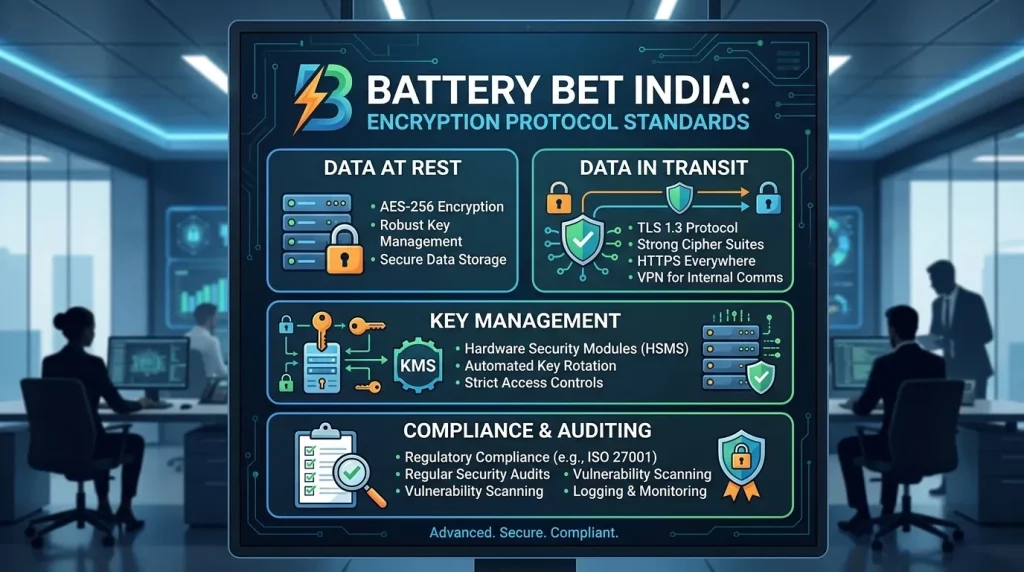
TLS and SSL at Battery Bet block others from reading traffic between points. These encryption protocol standards protect data when users connect to servers. They use protocol layers to change data into text. The operator uses keys for each session, which keep login details, transaction data, and account actions on endpoints.
What Are Encryption Protocol Standards
Protocol standards set rules that protect data during transfer. The protocol stack controls how the client and server pick cipher algorithms. It sets up keys. During handshake steps, the system checks certificates. It picks encryption methods.
- The protocol stack lays out each handshake step.
- Cipher suites name the permitted algorithms.
- TLS replaces all SSL versions.
- HTTPS uses TLS above HTTP.
- The system uses encryption and supports data integrity.
What Is TLS Operation Flow
TLS builds connections between client devices and Battery Bet India servers. The process starts with a handshake. This handshake sets up encryption. When setup finishes, later traffic moves through a channel.
- The client sends the server a list of cipher suites.
- The server returns a certificate.
- The client checks this certificate.
- Both parties use exchange to get session keys.
- Encryption begins.
- The channel stays open until the session ends or one party asks for renegotiation.
Data Transit Protection Methods
Transit protection uses keys and ciphers. These components secure every channel between client devices and Batery Bet India servers. After the handshake ends, encryption begins. The system manages each data transfer.
- TLS provides a path for data.
- Session keys control the process.
- AES encrypts every piece of data.
- Forward secrecy protects session data.
- Certificate validation confirms the server is genuine.
Algorithms move traffic.
Credential Encryption Flows
Login pages on Batery Bet use HTTPS for each transfer of credentials. Data moves inside a TLS tunnel before the server checks the information. This process cuts the risk of interception.
- The client starts a connection. A device sends a request to the server.
- The form sends the credentials over HTTPS. The form keeps the information in an encrypted state as it leaves the device.
- Batery Bet encrypts the stream. Each part of the transfer is protected through algorithms.
- The server checks the hash. It compares the hash to stored records to confirm each login.
- The session ends after logout.
Payment Data Cipher Suites
Payment transactions need cryptographic controls. Batery Bet India uses 256-bit encryption in every payment flow and data field. ECDHE is the key exchange at the start of each session. With every request, HMAC algorithms check message integrity.
- AES block cipher algorithm;
- ECDHE key exchange method;
- HMAC authentication code function;
- SHA hash function for integrity;
- 256-bit key length standard.
Mobile App Encryption Channels
Mobile connections use TLS. This protects data sent between Android devices, iOS browsers, and API endpoints. Each handshake triggers certificate validation. Session keys encrypt JSON payloads and authentication tokens. API responses use cipher standards, which protect web traffic from interception.
Batery Bet India encrypts traffic across all channels: Batery Bet India encrypts traffic on every channel.
- Android uses its native TLS stack;
- iOS browser encryption runs in the PWA;
- API endpoints undergo certificate validation checks;
- Session tokens move in transport;
- Push notifications use HTTPS for delivery.
Session Token Mechanics
Session management uses cookies and tokens. Tokens keep session identifiers. Each identifier links a request with stored data on the server. Cookies have flags. These flags send cookies only on HTTPS connections. Expiry windows create a time limit. Tokens stay valid for a period after creation.
Batery Bet India token handling practices: Batery Bet India has rules for token handling.
- The flag blocks tokens from leaking in cleartext;
- The HttpOnly setting stops scripts from getting tokens;
- The SameSite setting limits when cookies move between sites;
- The system changes each token after a login;
- Expiry rules fix a lifespan for each token.
What Are Key Rotation Cycles
RNG sources make the first cryptographic material. Developers get session keys when they use exchange methods such as ECDHE. Key rotation reduces risk from exposed credentials over time. Rotation schedules set intervals to replace old keys.
- RNG makes the first key material.
- Certificates renew once year.
- Exchange creates session keys.
- Systems remove old cryptographic material.
- Sessions refresh after renegotiation.
Data at Rest Encryption
Stored data needs more than transmission security. AES ciphers use key strengths of 128, 192, or 256 bits. When encryption logic stays separate from application code, it gets harder for threats to succeed. Key vault services hold the master key material. This key material allows access to both production data stores and backup archives.
Five layers protect inactive information:
- AES encryption at the database field level;
- Protection at the disk volume level;
- Keys that are kept separate for each backup archive;
- Key vault services that remain centralized and controlled;
- Access logs that record each decryption event.
Infrastructure Communication Hardening
Service mesh security uses TLS to encrypt communication between microservices and API endpoints. SFTP encrypts file transfers between storage nodes and application servers. Configuration management systems check server identities when they run deployment cycles. Admin dashboards require certificate validation before any user can get access.
Backend protection relies on several infrastructure methods: Backend protection relies on several infrastructure methods.
- Internal TLS encrypts service calls;
- Admin workflows need HTTPS enforcement rules;
- Tools use certificate validation;
- SFTP protects file movement;
- Monitoring agents send data through links.
Encrypted Traffic Monitoring Methods
Operators get handshake success rates and cipher adoption data. They do this without decrypting network traffic. Monitoring provides protocol metrics. If unusual protocols show up in traffic logs, the system sends alerts. Version tracking finds clients that use TLS 1.0 or 1.1. A failed handshake often signals a certificate issue or a cipher mismatch.
- Endpoint metrics show which TLS versions are in use.
- Dashboards show the cipher suites in operation.
- The system sends alerts if it detects a downgrade.
- Panels show the expiry dates for certificates.
- Logs keep records of failed handshakes.
Third Party Encryption Alignment
At integration points, external providers require that the protocol stays compliant.
- Payment partners use TLS 1.2.
- Gateways use HTTPS callback rules. Gateways run callback checks for every connection.
- The CDN ends TLS at the edge. The CDN applies this rule for all inbound traffic.
- Analytics load over HTTPS. Analytics scripts only load if the connection is secure.
- SSO redirects use protocols. The system checks protocol requirements during each SSO redirect.