
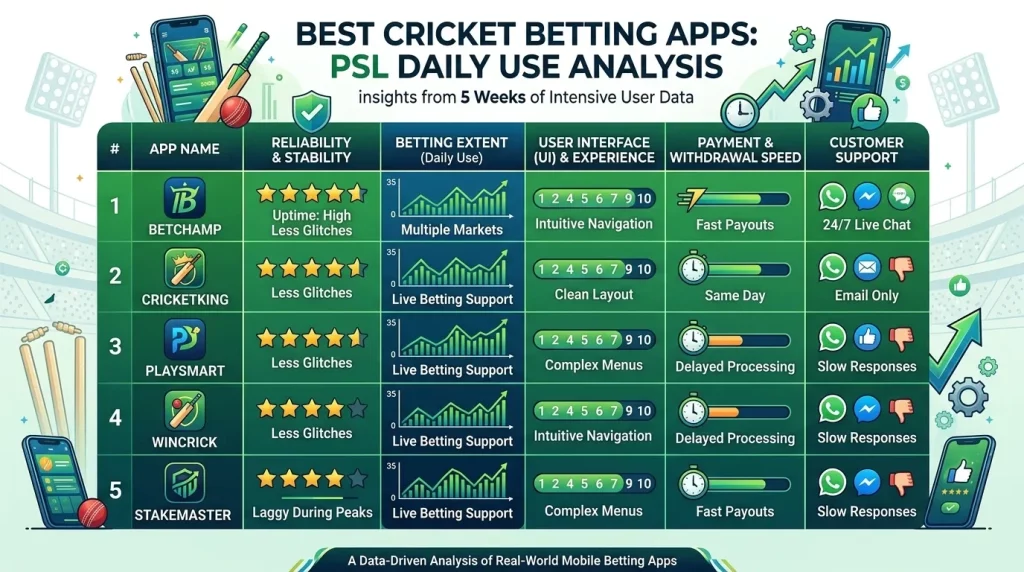
One football match on a Tuesday is likely to create very little app usage on a betting app. Betting activity is likely to show app usage to the extreme on a more active betting window like the PSL. Live betting is encouraging to experience on a more active betting window like PSL compared to the likely frozen screen on a less active window.
The PSL is a good stress test to see how daily loading activity impacts an app. In this case, daily matches (34) are likely to cause activity spikes.
Read the online betting app for a comparison of betting applications with Pakistani market data. What you are likely to see with activity that extends throughout the PSL is how app reliability, where failures seem to occur, and which performance indicators predict peak tournament activity are app-related performance issues.
The PSL Stress Test
The PSL is the most significant period for betting on the Pakistani calendar. During the PSL, there are daily matches that target the busy evening betting hours due to network congestion. Massive deposits to JazzCash and EasyPaisa are made during the thirty minutes before the toss. There are also the live betting markets that refresh between each delivery during the ninety minutes of play.
What load does to deposits
A deposit that takes two minutes to process on a calm morning takes four minutes on a PSL evening. The JazzCash system manages a much larger volume of transactions across all services, from bets to shopping, from bill payments to peer transfers, during late hours. All JazzCash transfers that happen at the same time compete for processing capacity, just like the betting app.
Compared to browser redirected JazzCash payments, apps that generate the payment request and process JazzCash payments in their app handle the situation much better. The integration is direct. The traversal through a web browser creates additional page loads and timeouts. The return path may fail to credit the balance, even if the payment is processed on the JazzCash side.
What load does to live betting
The live betting section during a PSL match with twenty thousand concurrent users behaves differently than during a county cricket match with two hundred. The odds update speed may slow by fractions of a second. The bet acceptance window may tighten. The cash out confirmation may take three seconds instead of one.
These micro-delays are measurable across a PSL season. An app that maintains sub-second odds updates during peak PSL evenings handles infrastructure better than one where the updates visibly lag behind the action on screen. The lag does not need to be dramatic to cost money – a two-second delay in odds update means you are looking at a price that no longer exists.
Best Betting Apps – Performance Indicators
Five indicators assess apps on a PSL season basis. They do not require expertise, but they do need observation and focus during day-to-day use.
- First is Speed of Deposit to Balance. Compare usual timing during the relatively quiet weekday morning, weekday evening and special event PSL match evening. Consistent timing shows good sportsbook infrastructure.
- Second is Live Odds. Good odds vary in pricing Wicket to Wicket. Bad odds are more than ten seconds stale, providing good moments to use your betting.
- Third is Cash Out. Perfect cash outs occur in one second.
- Fourth is the Crash and Restore. A sportsbook that clears when connection drops is bad and probably stops betting for the day.
- Fifth is the Withdrawal Window. Each app should stick to their stated limits. Frequent and/or arbitrary withdrawals should not mess the timing.
Lastly, the indicators continue with methods for your direct response, in case of connection dropout.
Deposit-to-balance speed
Time the deposit on three different occasions: a quiet morning, a weekday evening and a PSL match evening. Compare the three times. An app where all three fall within the same range handles load consistently. An app where the PSL evening deposit takes three times longer than the morning deposit has infrastructure that degrades under volume.
Live odds freshness
When watching a T20 match, pay attention to when a wicket falls. Count the seconds between the wicket falling and your screen updating the odds. When using a reliable app, the odds update within 3 to 5 seconds. With an unreliable booking app, the odds might stay for 10 seconds, which is long enough for a bettor to submit a wager at the outdated odds.
When your wager is placed at the outdated odds and the app automatically updates the odds and the wager is declined, this is referred to as a rejection-and-reoffer. An app’s slow updates for a wager would not be as big of a concern as an app allowing bets to be placed at outdated odds without notifying the user.
Cash out response time
During active matches, tap the cash out button and measure the time to confirmation. Under one second is excellent. One to two seconds is functional. Above three seconds creates situations where the offered value changes between your tap and the confirmation – the cash out you accepted at 850 PKR processes at 780 because a boundary was hit during the delay.
Crash and reconnection behaviour
Mobile data drops happen during evening hours when network load peaks. The question is what the app does when the connection returns. Does it restore the page you were on or drop you to the lobby? Does it maintain your active bet slip or clear it? Does the live match page resume updating or require a manual refresh?
An app that recovers gracefully from a connection drop saves time and prevents the frustration of rebuilding your position after every signal hiccup. An app that requires a full restart after each drop is functional but friction-heavy during an evening with unstable connectivity.
Withdrawal consistency
Request withdrawals on different days of the week and at different amounts. The processing time should remain within the stated range regardless of when the request is submitted. A withdrawal that processes in four hours on Monday but takes two days on Friday suggests batch processing that creates predictable delays. Knowing the pattern lets you time requests accordingly.
Betting App in Pakistan – What the Casino Section Reveals
The casino section provides a secondary reliability indicator. Casino games run on different server infrastructure than sports betting. If the sports section lags during a PSL match but the casino loads instantly, the bottleneck is in the sports infrastructure. If both lag simultaneously, the bottleneck is broader.
Crash games as a speed test
Crash games process rounds every few seconds. Each round requires server communication – the hash commitment before the round, the result transmission after. An app that runs crash games without delay during a PSL evening handles real-time processing well. An app where crash rounds hang or skip during peak hours reveals server capacity issues.
Live casino as a bandwidth test
The live casino stream consumes the most bandwidth of any section. If the roulette stream runs smoothly on your connection during peak evening hours, every other section will perform at least as well on the same connection. If the stream stutters, the connection is the limiting factor rather than the app.
This makes the live casino a useful diagnostic tool even if you do not plan to play it regularly. Five minutes of live roulette streaming during a PSL evening tells you whether your connection supports the most demanding section. If it does, live cricket odds, crash games and slots will all function without bandwidth-related issues.
Monthly Tracking Through Mobile Banking
JazzCash and EasyPaisa transaction histories provide built-in expense tracking that desktop bank statements make harder to parse. Every deposit to the platform appears as an outgoing transaction. Every withdrawal appears as incoming. The difference is the monthly cost.
What to measure weekly
Total platform outgoings, total platform incomings, and total number of individual deposits. These three numbers say all that need to be said.
The third number explains the regularity of deposits. A deposit of 5,000 PKR is the same as ten deposits of 500 PKR, but the motivations are different. It’s a sign of poor control to repeatedly top up in small increments following a loss, as opposed to making an organized deposit to start a session. Depositing in excess of the originally intended number of sessions means a budget was set, but consideration to keep playing after the set limit was not taken.
PSL month versus normal month
Compare the PSL month totals with a normal month. The difference reveals how much the tournament density drove additional spending. If the PSL month cost twice the normal month, the daily match schedule doubled the betting activity. Whether that doubling was planned and budgeted or impulsive and untracked determines whether the PSL was entertainment or expense.
What Five Weeks Teach
A full PSL season of daily app usage generates data that no review can match. How the deposit speed behaves under pressure. How fresh the live odds are during the peak of concurrent users. How reliable the cash out is amid the chaos of death overs. How the app behaves when 4G drops and reconnects. How consistent the withdrawal is across different days and amounts.
This is a rigorous test. In the PSL, 34 matches are played, and there are multiple casino sessions. The app handles all five of the above challenges. It also has faced all the challenges The PSL has to offer. The next challenge of similar complexity is dealing with a Pakistan international series. However, this series only has 3 to 5 matches. If an app has passed the PSL challenge, it can handle anything else that the cricket calendar brings.
During the PSL, the apps that did not manage deposits became evident. For example, deposits that lagged during evening matches. Live odds that persist at stale prices. Cash out that is not processed at the changed value. Reconnection that drops the bet slip. Each failure provides feedback that determines whether the app has earned the right for continued use or whether the app is replaced before the next season.
It is a test at minimum deposit that establishes the baseline. The PSL season is the actual test of whether that baseline can be sustained. Both pieces of information are critical. If only one piece is available, it is not enough. The baseline is informative in that it tells you whether the app can work. The second piece is how the app works when it matters.